A tower built to be seen
The Berlin TV Tower was never meant to hide in the skyline. It was designed to dominate it, to symbolize modernity, and to make a statement visible from almost everywhere in the city.
Table of Contents
Why East Berlin wanted a landmark in the sky
The story of the Berlin TV Tower begins in the years when Berlin was not one city in practice, but two rival systems forced to face one another every day. After the Second World War, and especially once the Cold War hardened into physical separation, East Berlin needed symbols. Not small ones, either. The leadership of the German Democratic Republic wanted architecture that announced confidence, technical competence, and ideological modernity. In a city where prestige mattered politically as much as practically, a giant telecommunications and observation tower could do several jobs at once. It could improve broadcasting, reshape the skyline, and send an unmistakable visual message: East Berlin was not a historical relic living in the shadow of the West, but a capital of the future.
That ambition helps explain why the TV Tower feels so different from older Berlin landmarks. It was not built gradually over centuries or tied to a royal court, a church, or a merchant past. It was born in an era of plans, state messaging, engineering targets, and urban redesign. The authorities wanted something visible from great distances, something so prominent that residents and visitors alike would absorb its message almost unconsciously. Look up, and there it was. In that sense, the tower was never just infrastructure. From the very beginning, it was also theater, symbolism, and skyline politics rendered in concrete, steel, and reflective panels.
Planning a socialist showpiece
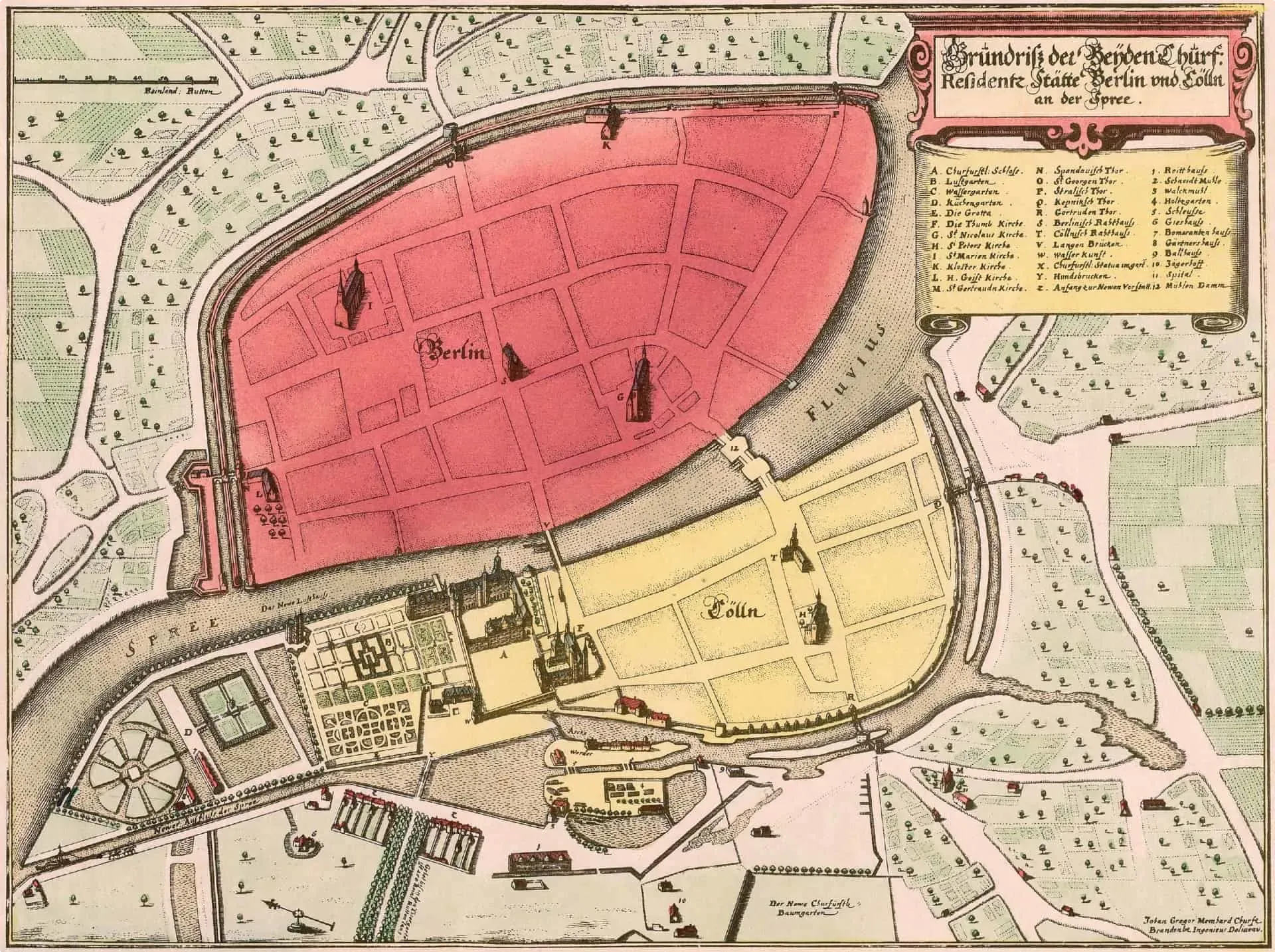
Before the famous sphere ever rose over Alexanderplatz, the tower existed as an idea shaped by competing priorities: technical need, ideological ambition, cost, visibility, and urban planning. Earlier broadcasting-tower concepts had been discussed for other parts of the city, but the final decision to place the structure near Alexanderplatz was deeply strategic. This was the heart of East Berlin's urban renewal project, an area meant to embody a modern socialist capital with wide spaces, strong axes, transport links, and monumental public architecture. Positioning the tower here ensured that it would not stand as an isolated object. It would become part of a broader architectural composition, looming over squares, administrative buildings, transport infrastructure, and public life.
The planning stage also reflected the contradictions of the era. The tower was presented as a symbol of collective progress, yet it relied on highly controlled decision-making from above. It was promoted as a practical achievement, yet aesthetics and political messaging clearly mattered just as much. Even the final form had to balance spectacle and discipline: bold enough to inspire awe, rational enough to look like the natural product of technical excellence. That tension gives the Fernsehturm much of its character even today. It is elegant, but never shy. Futuristic, but unmistakably shaped by the 1960s faith that the future could be designed, measured, and broadcast to the masses.
Building the tower at Alexanderplatz
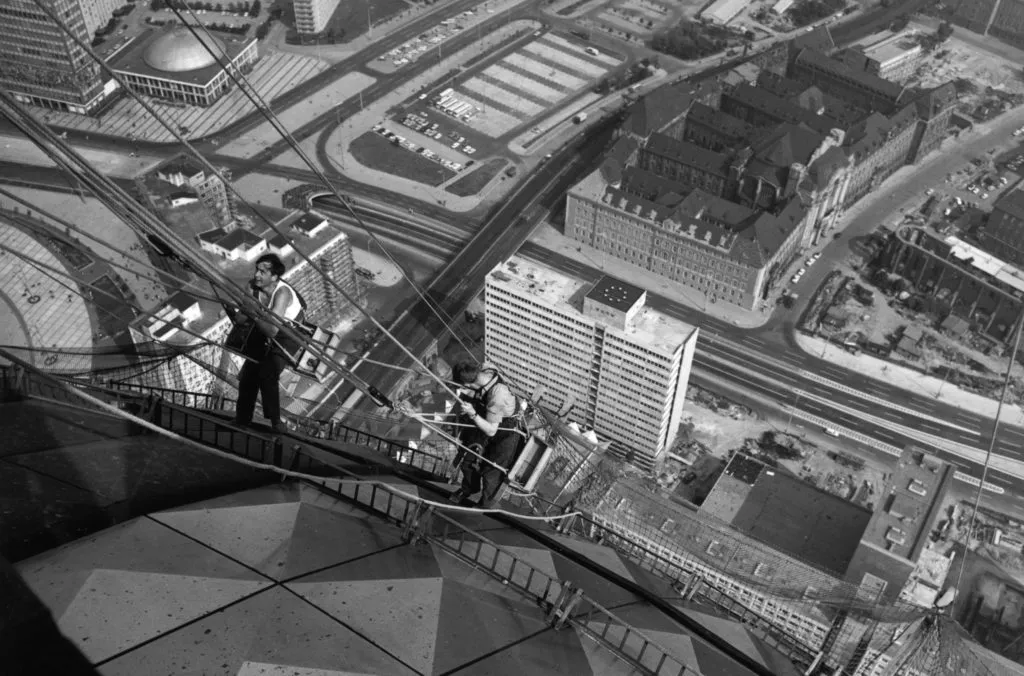
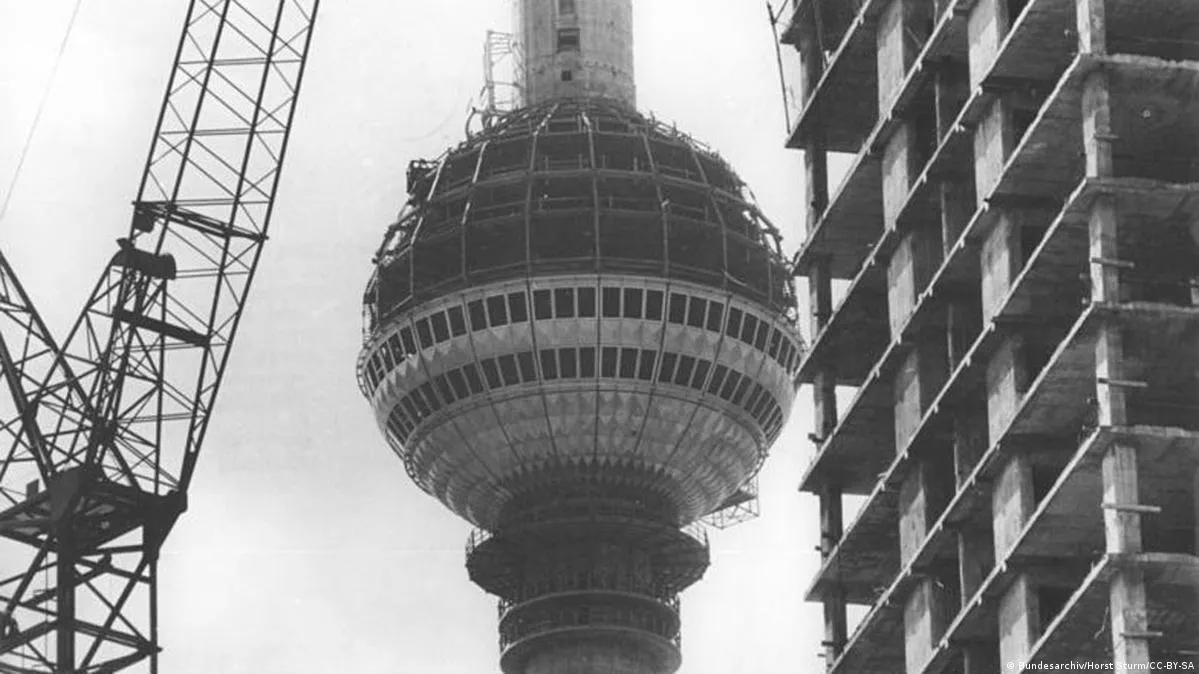
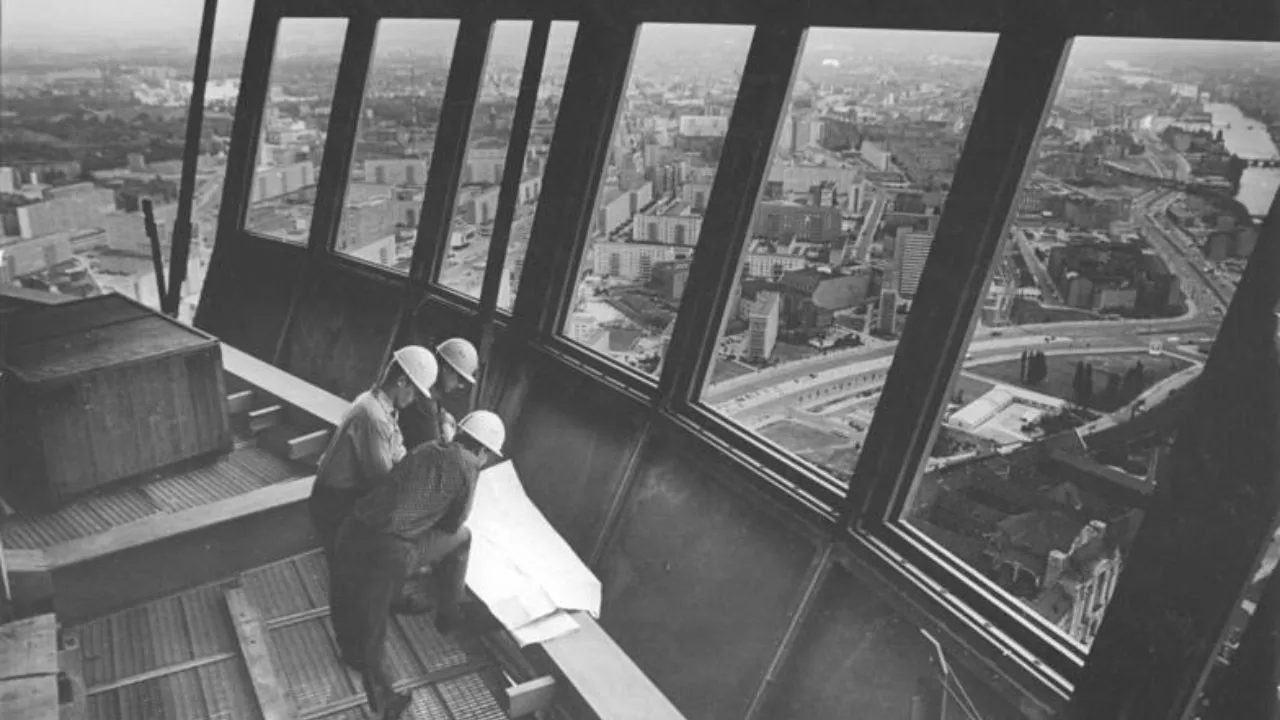
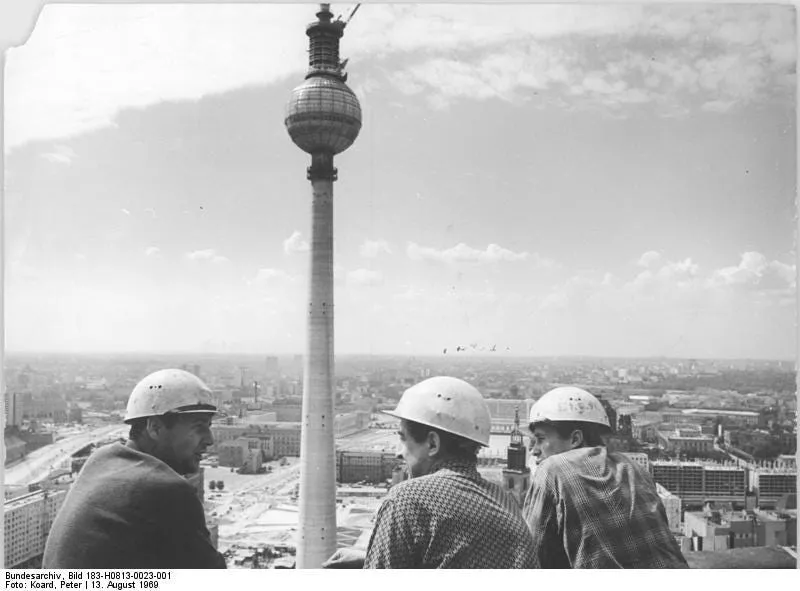
Construction turned the ambition into a public reality. Rising in the late 1960s, the Berlin TV Tower was built using methods and materials that had to meet enormous structural demands. The shaft climbed upward with a severity that still feels striking today: clean, narrow, and almost impossibly vertical when seen from below. The sphere, now the tower's most famous visual feature, had to be assembled with precision high above the city. For ordinary Berliners, the project would have been impossible to ignore. Bit by bit, the skyline changed. What had started as an abstract state project became a daily presence visible from streets, windows, stations, and empty lots across East Berlin and beyond.
Its placement at Alexanderplatz amplified that effect. This was not a tower hidden in a remote technical district. It rose in one of the city's busiest urban zones, where everyday routines unfolded beneath a structure built to symbolize a new era. Commuters, shoppers, officials, schoolchildren, and foreign visitors all moved through the square under the growing silhouette. By the time the tower was completed and opened, it had already become more than a construction project. It had become a psychological landmark, something people oriented themselves by, argued about, admired, or quietly resented, depending on what they felt about the state that commissioned it.
An engineering feat and a propaganda tool
Technically, the Berlin TV Tower was a serious achievement. It was designed to support broadcasting functions while also welcoming visitors high above the city, which meant engineering for safety, reliability, wind resistance, and the unusual combination of utility and spectacle. But it would be incomplete to describe it as merely a feat of engineering, because the state that built it absolutely understood its propaganda value. Height matters in cities, and not only because of the view. Height commands attention. Height implies control, reach, and confidence. In divided Berlin, every highly visible structure carried political meaning, and the Fernsehturm was one of the clearest statements the East could make.
This dual identity is one reason the tower remains so compelling. Unlike monuments that acquired political meaning later, the TV Tower was political from the outset. It was built to signal progress, to dramatize technological competence, and to anchor East Berlin's image as a capital looking forward. Yet its message was never fully controllable. People could admire the view while doubting the ideology. They could appreciate the elegance of the structure while mocking the seriousness of the state narrative. And that unpredictability, ironically, is part of what has allowed the tower to outlive the system that built it.
Life beneath the sphere in divided Berlin

For those living in East Berlin, the TV Tower was not just a postcard image. It was part of the texture of everyday life. It stood above shopping trips, work commutes, state parades, school excursions, and ordinary meetings in Alexanderplatz. Seen from a tram stop, from a residential estate, from a government office, or from a gray winter street, the tower could look futuristic, reassuring, imposing, or absurd depending on the weather and the political mood. That is often what makes famous landmarks truly interesting: they are not only admired by visitors but absorbed into the habits and emotional geography of the people around them.
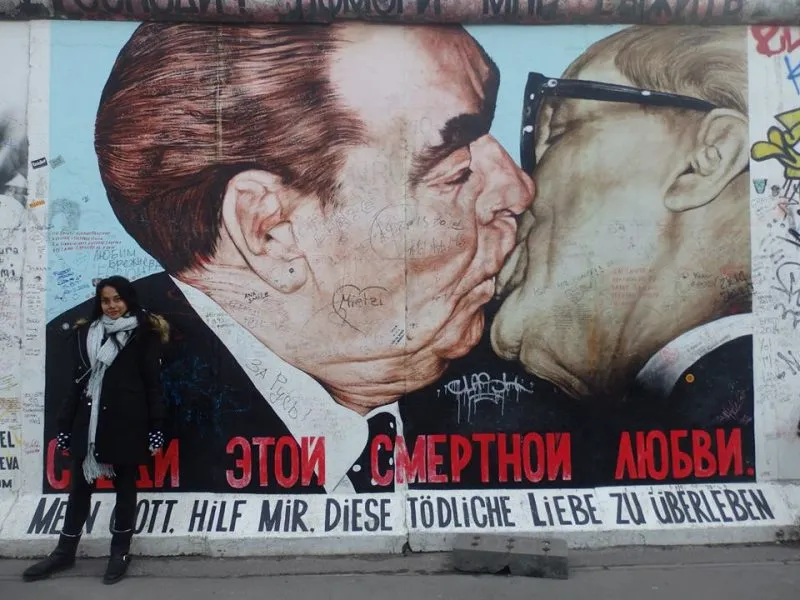
For West Berliners, meanwhile, the tower occupied a different role. It was visible across the divided city, a reminder that the East too was building its own symbols of modernity. In that sense, the Fernsehturm became part of Berlin's strange visual dialogue during the Cold War. Walls and checkpoints separated people on the ground, but the skyline ignored those boundaries. The tower stood there for everyone to see, whether they interpreted it as triumph, spectacle, provocation, or simply an oddly beautiful object in a fractured city.
The Pope's Revenge and other local myths
No landmark of this scale survives on official meaning alone. Berliners are too ironic for that. Over time, the TV Tower gathered stories, jokes, and nicknames that softened, complicated, or quietly undermined its official image. The best-known example is the shining cross-shaped reflection that appears on the sphere when sunlight hits it in certain conditions. In an officially atheist socialist state, many people delighted in the irony and nicknamed the effect the Pope's Revenge. Whether told as a joke, a whisper, or an act of small symbolic resistance, the story became part of the tower's folklore.
These local myths matter because they reveal how people reclaim monumental architecture. Governments may commission buildings for one purpose, but cities always rewrite them through humor, memory, and repetition. The Berlin TV Tower became not just the object of official pride, but also of everyday commentary. It could be grand and faintly ridiculous at the same time, which is a very Berlin combination. That tension has helped keep it alive in public affection long after more rigid state symbols lost their relevance.
What changed after German reunification
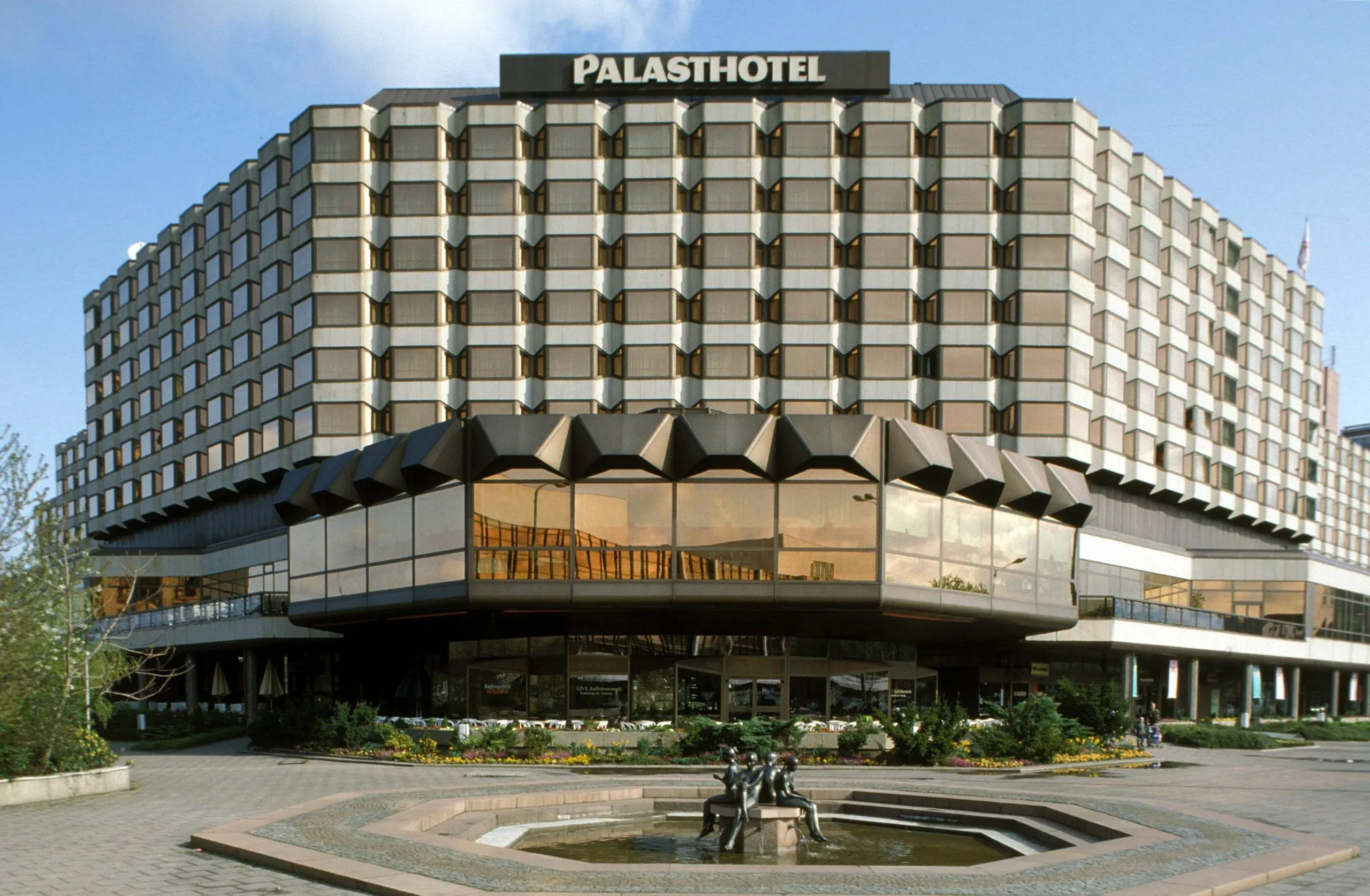
When Germany reunified, many East German symbols entered a difficult period. Some were demolished, some were neglected, and others were reinterpreted. The Berlin TV Tower survived not only because it remained useful, but because it had already become inseparable from the image of the city itself. Reunified Berlin could easily have treated it as an awkward reminder of the GDR, yet that never quite happened. Instead, the tower shifted categories. It stopped being primarily a state statement and became a city landmark in the broadest sense: open to tourists, embedded in postcards, adopted into popular memory, and folded into the visual identity of Berlin as a whole.
That transformation is one of the most interesting parts of its history. The same structure that once symbolized a divided ideological landscape now helps tell the story of a city that absorbed its contradictions rather than erasing them. Today, many visitors know the tower first as a skyline icon, not a Cold War message. Yet the political layer never fully disappears, and that is exactly why it remains worth visiting. It is a reminder that Berlin's most famous sights are rarely neutral. They carry the marks of regimes, ambitions, reinventions, and reinterpretations.
Visiting the tower today
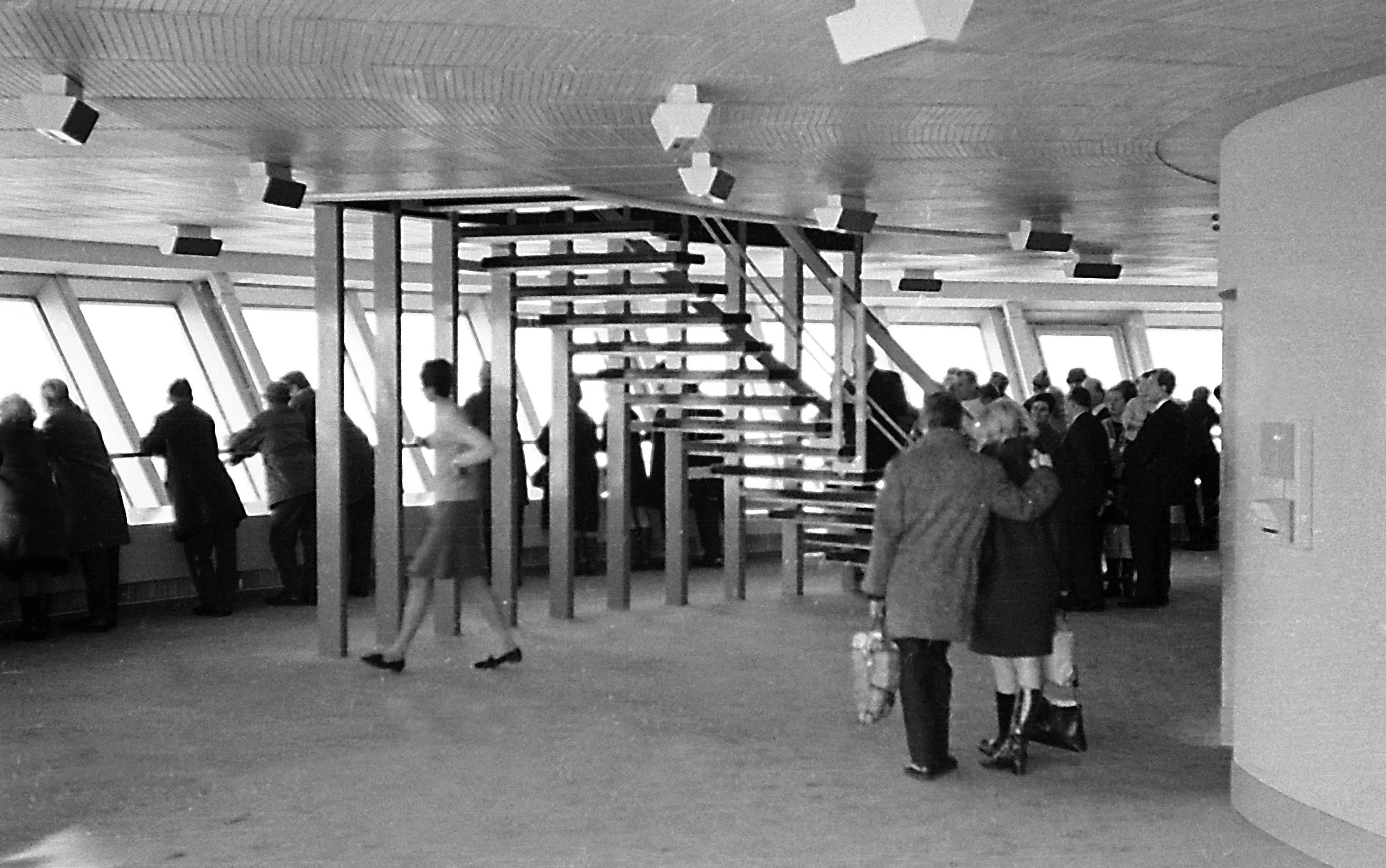
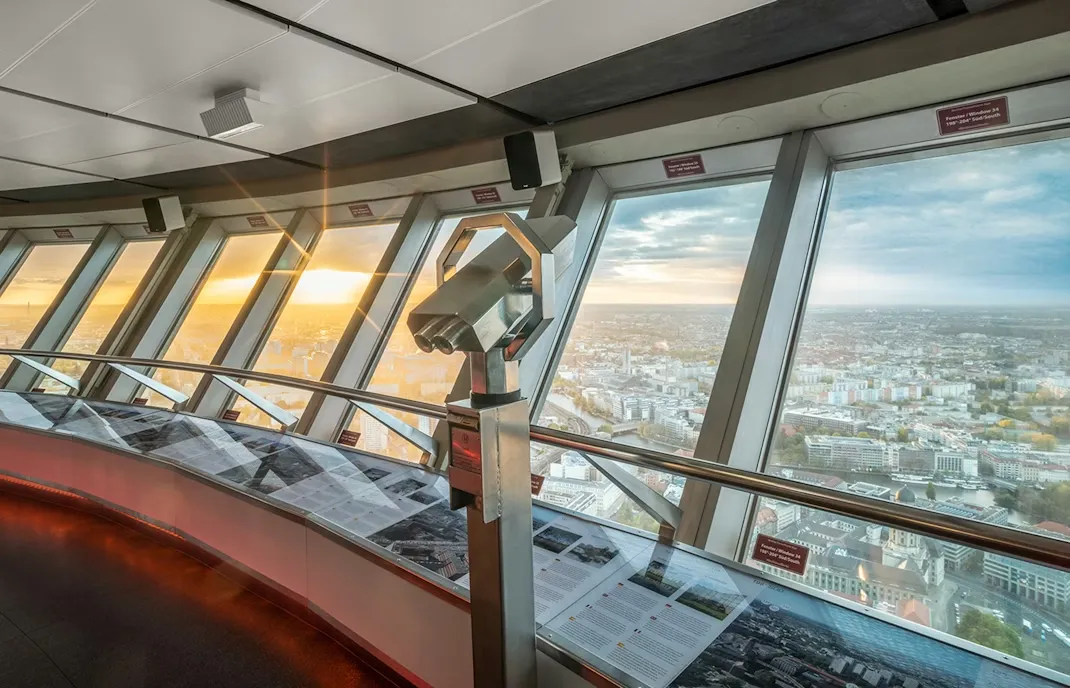
Today the Berlin TV Tower functions as one of the easiest ways to grasp the city spatially. From street level, Berlin can feel diffuse. Its major sights are spread out, its historic center was repeatedly broken and rebuilt, and many of its most important districts do not cluster together in the neat way visitors expect from older European capitals. From the top of the tower, that complexity becomes visible in one sweep. You can trace the line of grand avenues, pick out church domes and postwar housing blocks, and see how green spaces interrupt the dense fabric of the center.
The modern visitor experience is more streamlined than symbolic, but the history has not vanished. In fact, the contrast is part of the appeal. You may arrive thinking mainly about the view, then leave remembering how much of Berlin's identity is wrapped up in reinvention. The TV Tower delivers spectacle, but it also rewards curiosity. Even a short visit can connect architecture, politics, urban planning, memory, and tourism in a way that feels distinctly Berlin.
Architecture, materials & design details
Architecturally, the Berlin TV Tower is memorable because it reduces its drama to a few bold elements: a slender concrete shaft, a gleaming sphere, and a long antenna extending into the sky. There is very little decorative distraction. The design relies on clarity, proportion, and contrast. From a distance, it can look almost abstract, as though someone drew the idea of a future-oriented city landmark with a single decisive line and a polished metallic circle.
That simplicity is deceptive. The building's visual force depends on scale, surface, and siting. The sphere catches changing light throughout the day, sometimes looking silver and weightless, sometimes dense and reflective against flat Berlin skies. From the ground, the shaft appears almost severe; from afar, the whole composition feels balanced and elegant. It is one of those structures that can seem colder than older monuments at first glance, yet the longer you look, the more character it reveals.
The tower in films, postcards & memory
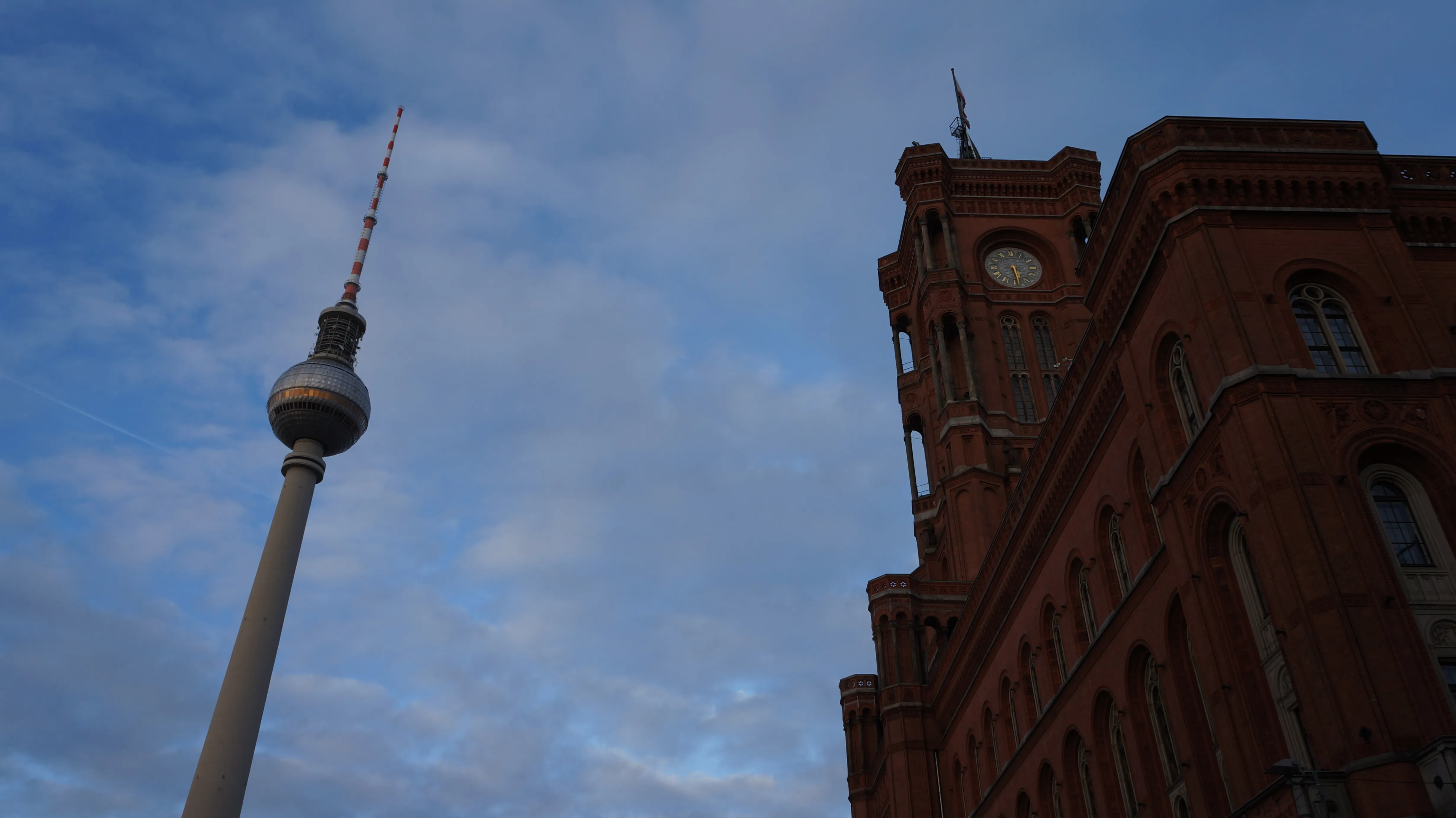
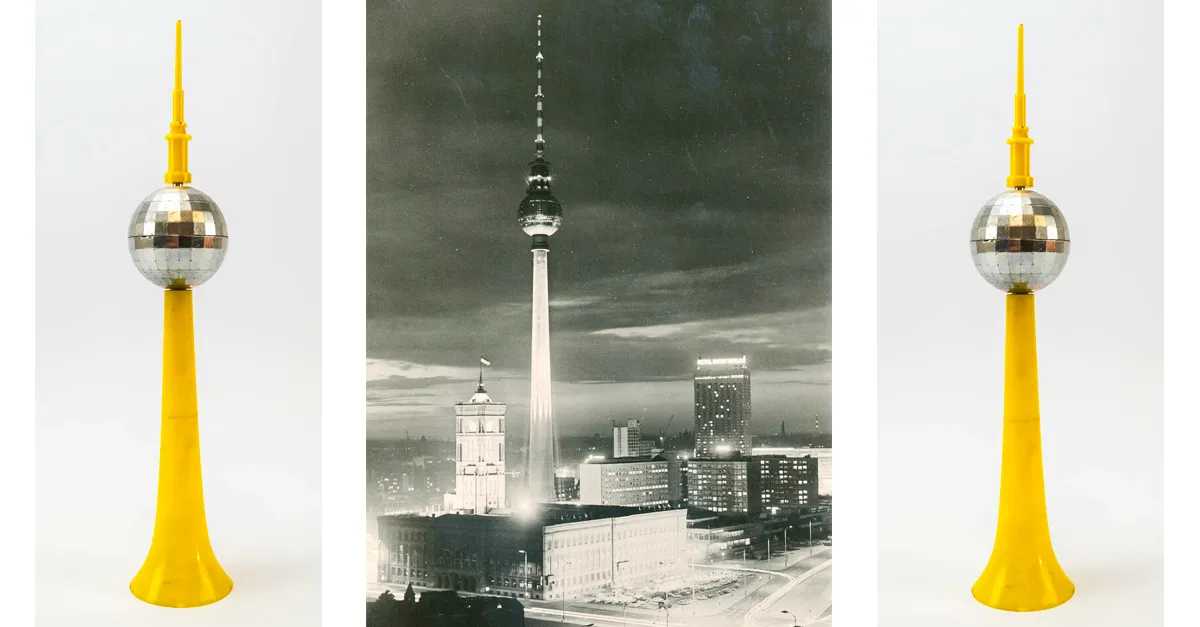
The Berlin TV Tower appears constantly in the visual language of the city. It turns up in films, travel photography, postcards, skyline logos, souvenir prints, and aerial shots used whenever someone needs to say 'this is Berlin' in a single frame. That repeat visibility matters because it reinforces the tower's status across generations, including people who may never have gone to the top themselves. Many landmarks are famous locally or internationally. The Fernsehturm is both.
And yet its image is not static. In one context, it suggests the optimism and control projected by the 1960s East German state. In another, it evokes nightlife, reunified Berlin, and a cosmopolitan capital comfortable with its layered past. A snowy winter photograph, a sharp summer skyline, a moody Cold War documentary shot, and a glossy tourism campaign can all use the same tower and mean completely different things. Few urban structures are so visually stable and symbolically flexible at the same time.
Why Berliners still argue about it
Berliners do not always agree on what their city should look like, remember, or celebrate, and the TV Tower sits right inside those arguments. Some see it as a brilliant survivor: elegant, unmistakable, and more visually successful than many newer landmarks. Others regard it as an authoritarian relic, the polished spear of a regime that wanted visibility and control. Many feel both things at once. That ambiguity is not a weakness. It is part of what makes the tower feel honest within Berlin's broader story.
Cities become shallow when every landmark is reduced to marketing. Berlin resists that, and the TV Tower is a good example of why. It is photogenic, yes, but also contested, inherited, and politically charged. People still debate what it represents because Berlin itself still debates how to live with the twentieth century. A tower that can trigger those conversations is doing more than decorating the skyline.
Interesting facts before you visit
A few details make the Berlin TV Tower even more enjoyable once you know them in advance. It is commonly called the Fernsehturm, which simply means television tower. The famous reflective cross effect on the sphere became one of the city's most mischievous Cold War legends. The tower was built in the late 1960s, in the era when East Berlin was reshaping Alexanderplatz into a statement of modern urban life. And although many visitors think of Berlin as a low-rise city, the tower gives you a surprisingly strong sense of just how vast and spread out the capital really is.
Another good thing to remember is that the weather changes the entire mood of the visit. A bright morning makes the city look crisp and almost map-like. A cloudy afternoon can make Berlin feel dramatic and cinematic. At sunset, the river and glass facades catch the light, while night transforms the city into a web of moving headlights and illuminated stations. In other words, there is no single correct time to go. The atmosphere shifts, and that is part of the tower's charm.
Why the Berlin TV Tower still matters

The Berlin TV Tower still matters because it compresses so much of Berlin into one vertical experience. It is a Cold War object that survived the Cold War. It is a technical structure that became a civic emblem. It is a former East German prestige project that now belongs to the imagination of the whole city. And for visitors, it offers something rare: not just a high view, but a clearer understanding of how Berlin fits together physically and historically.
That is why a visit here often lingers in memory longer than expected. You do not only remember the height. You remember the strange calm after the elevator doors open, the way familiar names on a map become visible places, and the realization that Berlin's identity is written not in one monument or one era, but in layers. The TV Tower lets you see those layers at once. Few attractions do that so simply, and so effectively.
Table of Contents
Why East Berlin wanted a landmark in the sky
The story of the Berlin TV Tower begins in the years when Berlin was not one city in practice, but two rival systems forced to face one another every day. After the Second World War, and especially once the Cold War hardened into physical separation, East Berlin needed symbols. Not small ones, either. The leadership of the German Democratic Republic wanted architecture that announced confidence, technical competence, and ideological modernity. In a city where prestige mattered politically as much as practically, a giant telecommunications and observation tower could do several jobs at once. It could improve broadcasting, reshape the skyline, and send an unmistakable visual message: East Berlin was not a historical relic living in the shadow of the West, but a capital of the future.
That ambition helps explain why the TV Tower feels so different from older Berlin landmarks. It was not built gradually over centuries or tied to a royal court, a church, or a merchant past. It was born in an era of plans, state messaging, engineering targets, and urban redesign. The authorities wanted something visible from great distances, something so prominent that residents and visitors alike would absorb its message almost unconsciously. Look up, and there it was. In that sense, the tower was never just infrastructure. From the very beginning, it was also theater, symbolism, and skyline politics rendered in concrete, steel, and reflective panels.
Planning a socialist showpiece
Before the famous sphere ever rose over Alexanderplatz, the tower existed as an idea shaped by competing priorities: technical need, ideological ambition, cost, visibility, and urban planning. Earlier broadcasting-tower concepts had been discussed for other parts of the city, but the final decision to place the structure near Alexanderplatz was deeply strategic. This was the heart of East Berlin's urban renewal project, an area meant to embody a modern socialist capital with wide spaces, strong axes, transport links, and monumental public architecture. Positioning the tower here ensured that it would not stand as an isolated object. It would become part of a broader architectural composition, looming over squares, administrative buildings, transport infrastructure, and public life.
The planning stage also reflected the contradictions of the era. The tower was presented as a symbol of collective progress, yet it relied on highly controlled decision-making from above. It was promoted as a practical achievement, yet aesthetics and political messaging clearly mattered just as much. Even the final form had to balance spectacle and discipline: bold enough to inspire awe, rational enough to look like the natural product of technical excellence. That tension gives the Fernsehturm much of its character even today. It is elegant, but never shy. Futuristic, but unmistakably shaped by the 1960s faith that the future could be designed, measured, and broadcast to the masses.
Building the tower at Alexanderplatz
Construction turned the ambition into a public reality. Rising in the late 1960s, the Berlin TV Tower was built using methods and materials that had to meet enormous structural demands. The shaft climbed upward with a severity that still feels striking today: clean, narrow, and almost impossibly vertical when seen from below. The sphere, now the tower's most famous visual feature, had to be assembled with precision high above the city. For ordinary Berliners, the project would have been impossible to ignore. Bit by bit, the skyline changed. What had started as an abstract state project became a daily presence visible from streets, windows, stations, and empty lots across East Berlin and beyond.
Its placement at Alexanderplatz amplified that effect. This was not a tower hidden in a remote technical district. It rose in one of the city's busiest urban zones, where everyday routines unfolded beneath a structure built to symbolize a new era. Commuters, shoppers, officials, schoolchildren, and foreign visitors all moved through the square under the growing silhouette. By the time the tower was completed and opened, it had already become more than a construction project. It had become a psychological landmark, something people oriented themselves by, argued about, admired, or quietly resented, depending on what they felt about the state that commissioned it.
An engineering feat and a propaganda tool
Technically, the Berlin TV Tower was a serious achievement. It was designed to support broadcasting functions while also welcoming visitors high above the city, which meant engineering for safety, reliability, wind resistance, and the unusual combination of utility and spectacle. But it would be incomplete to describe it as merely a feat of engineering, because the state that built it absolutely understood its propaganda value. Height matters in cities, and not only because of the view. Height commands attention. Height implies control, reach, and confidence. In divided Berlin, every highly visible structure carried political meaning, and the Fernsehturm was one of the clearest statements the East could make.
This dual identity is one reason the tower remains so compelling. Unlike monuments that acquired political meaning later, the TV Tower was political from the outset. It was built to signal progress, to dramatize technological competence, and to anchor East Berlin's image as a capital looking forward. Yet its message was never fully controllable. People could admire the view while doubting the ideology. They could appreciate the elegance of the structure while mocking the seriousness of the state narrative. And that unpredictability, ironically, is part of what has allowed the tower to outlive the system that built it.
Life beneath the sphere in divided Berlin
For those living in East Berlin, the TV Tower was not just a postcard image. It was part of the texture of everyday life. It stood above shopping trips, work commutes, state parades, school excursions, and ordinary meetings in Alexanderplatz. Seen from a tram stop, from a residential estate, from a government office, or from a gray winter street, the tower could look futuristic, reassuring, imposing, or absurd depending on the weather and the political mood. That is often what makes famous landmarks truly interesting: they are not only admired by visitors but absorbed into the habits and emotional geography of the people around them.
For West Berliners, meanwhile, the tower occupied a different role. It was visible across the divided city, a reminder that the East too was building its own symbols of modernity. In that sense, the Fernsehturm became part of Berlin's strange visual dialogue during the Cold War. Walls and checkpoints separated people on the ground, but the skyline ignored those boundaries. The tower stood there for everyone to see, whether they interpreted it as triumph, spectacle, provocation, or simply an oddly beautiful object in a fractured city.
The Pope's Revenge and other local myths
No landmark of this scale survives on official meaning alone. Berliners are too ironic for that. Over time, the TV Tower gathered stories, jokes, and nicknames that softened, complicated, or quietly undermined its official image. The best-known example is the shining cross-shaped reflection that appears on the sphere when sunlight hits it in certain conditions. In an officially atheist socialist state, many people delighted in the irony and nicknamed the effect the Pope's Revenge. Whether told as a joke, a whisper, or an act of small symbolic resistance, the story became part of the tower's folklore.
These local myths matter because they reveal how people reclaim monumental architecture. Governments may commission buildings for one purpose, but cities always rewrite them through humor, memory, and repetition. The Berlin TV Tower became not just the object of official pride, but also of everyday commentary. It could be grand and faintly ridiculous at the same time, which is a very Berlin combination. That tension has helped keep it alive in public affection long after more rigid state symbols lost their relevance.
What changed after German reunification
When Germany reunified, many East German symbols entered a difficult period. Some were demolished, some were neglected, and others were reinterpreted. The Berlin TV Tower survived not only because it remained useful, but because it had already become inseparable from the image of the city itself. Reunified Berlin could easily have treated it as an awkward reminder of the GDR, yet that never quite happened. Instead, the tower shifted categories. It stopped being primarily a state statement and became a city landmark in the broadest sense: open to tourists, embedded in postcards, adopted into popular memory, and folded into the visual identity of Berlin as a whole.
That transformation is one of the most interesting parts of its history. The same structure that once symbolized a divided ideological landscape now helps tell the story of a city that absorbed its contradictions rather than erasing them. Today, many visitors know the tower first as a skyline icon, not a Cold War message. Yet the political layer never fully disappears, and that is exactly why it remains worth visiting. It is a reminder that Berlin's most famous sights are rarely neutral. They carry the marks of regimes, ambitions, reinventions, and reinterpretations.
Visiting the tower today
Today the Berlin TV Tower functions as one of the easiest ways to grasp the city spatially. From street level, Berlin can feel diffuse. Its major sights are spread out, its historic center was repeatedly broken and rebuilt, and many of its most important districts do not cluster together in the neat way visitors expect from older European capitals. From the top of the tower, that complexity becomes visible in one sweep. You can trace the line of grand avenues, pick out church domes and postwar housing blocks, and see how green spaces interrupt the dense fabric of the center.
The modern visitor experience is more streamlined than symbolic, but the history has not vanished. In fact, the contrast is part of the appeal. You may arrive thinking mainly about the view, then leave remembering how much of Berlin's identity is wrapped up in reinvention. The TV Tower delivers spectacle, but it also rewards curiosity. Even a short visit can connect architecture, politics, urban planning, memory, and tourism in a way that feels distinctly Berlin.
Architecture, materials & design details
Architecturally, the Berlin TV Tower is memorable because it reduces its drama to a few bold elements: a slender concrete shaft, a gleaming sphere, and a long antenna extending into the sky. There is very little decorative distraction. The design relies on clarity, proportion, and contrast. From a distance, it can look almost abstract, as though someone drew the idea of a future-oriented city landmark with a single decisive line and a polished metallic circle.
That simplicity is deceptive. The building's visual force depends on scale, surface, and siting. The sphere catches changing light throughout the day, sometimes looking silver and weightless, sometimes dense and reflective against flat Berlin skies. From the ground, the shaft appears almost severe; from afar, the whole composition feels balanced and elegant. It is one of those structures that can seem colder than older monuments at first glance, yet the longer you look, the more character it reveals.
The tower in films, postcards & memory
The Berlin TV Tower appears constantly in the visual language of the city. It turns up in films, travel photography, postcards, skyline logos, souvenir prints, and aerial shots used whenever someone needs to say 'this is Berlin' in a single frame. That repeat visibility matters because it reinforces the tower's status across generations, including people who may never have gone to the top themselves. Many landmarks are famous locally or internationally. The Fernsehturm is both.
And yet its image is not static. In one context, it suggests the optimism and control projected by the 1960s East German state. In another, it evokes nightlife, reunified Berlin, and a cosmopolitan capital comfortable with its layered past. A snowy winter photograph, a sharp summer skyline, a moody Cold War documentary shot, and a glossy tourism campaign can all use the same tower and mean completely different things. Few urban structures are so visually stable and symbolically flexible at the same time.
Why Berliners still argue about it
Berliners do not always agree on what their city should look like, remember, or celebrate, and the TV Tower sits right inside those arguments. Some see it as a brilliant survivor: elegant, unmistakable, and more visually successful than many newer landmarks. Others regard it as an authoritarian relic, the polished spear of a regime that wanted visibility and control. Many feel both things at once. That ambiguity is not a weakness. It is part of what makes the tower feel honest within Berlin's broader story.
Cities become shallow when every landmark is reduced to marketing. Berlin resists that, and the TV Tower is a good example of why. It is photogenic, yes, but also contested, inherited, and politically charged. People still debate what it represents because Berlin itself still debates how to live with the twentieth century. A tower that can trigger those conversations is doing more than decorating the skyline.
Interesting facts before you visit
A few details make the Berlin TV Tower even more enjoyable once you know them in advance. It is commonly called the Fernsehturm, which simply means television tower. The famous reflective cross effect on the sphere became one of the city's most mischievous Cold War legends. The tower was built in the late 1960s, in the era when East Berlin was reshaping Alexanderplatz into a statement of modern urban life. And although many visitors think of Berlin as a low-rise city, the tower gives you a surprisingly strong sense of just how vast and spread out the capital really is.
Another good thing to remember is that the weather changes the entire mood of the visit. A bright morning makes the city look crisp and almost map-like. A cloudy afternoon can make Berlin feel dramatic and cinematic. At sunset, the river and glass facades catch the light, while night transforms the city into a web of moving headlights and illuminated stations. In other words, there is no single correct time to go. The atmosphere shifts, and that is part of the tower's charm.
Why the Berlin TV Tower still matters
The Berlin TV Tower still matters because it compresses so much of Berlin into one vertical experience. It is a Cold War object that survived the Cold War. It is a technical structure that became a civic emblem. It is a former East German prestige project that now belongs to the imagination of the whole city. And for visitors, it offers something rare: not just a high view, but a clearer understanding of how Berlin fits together physically and historically.
That is why a visit here often lingers in memory longer than expected. You do not only remember the height. You remember the strange calm after the elevator doors open, the way familiar names on a map become visible places, and the realization that Berlin's identity is written not in one monument or one era, but in layers. The TV Tower lets you see those layers at once. Few attractions do that so simply, and so effectively.